

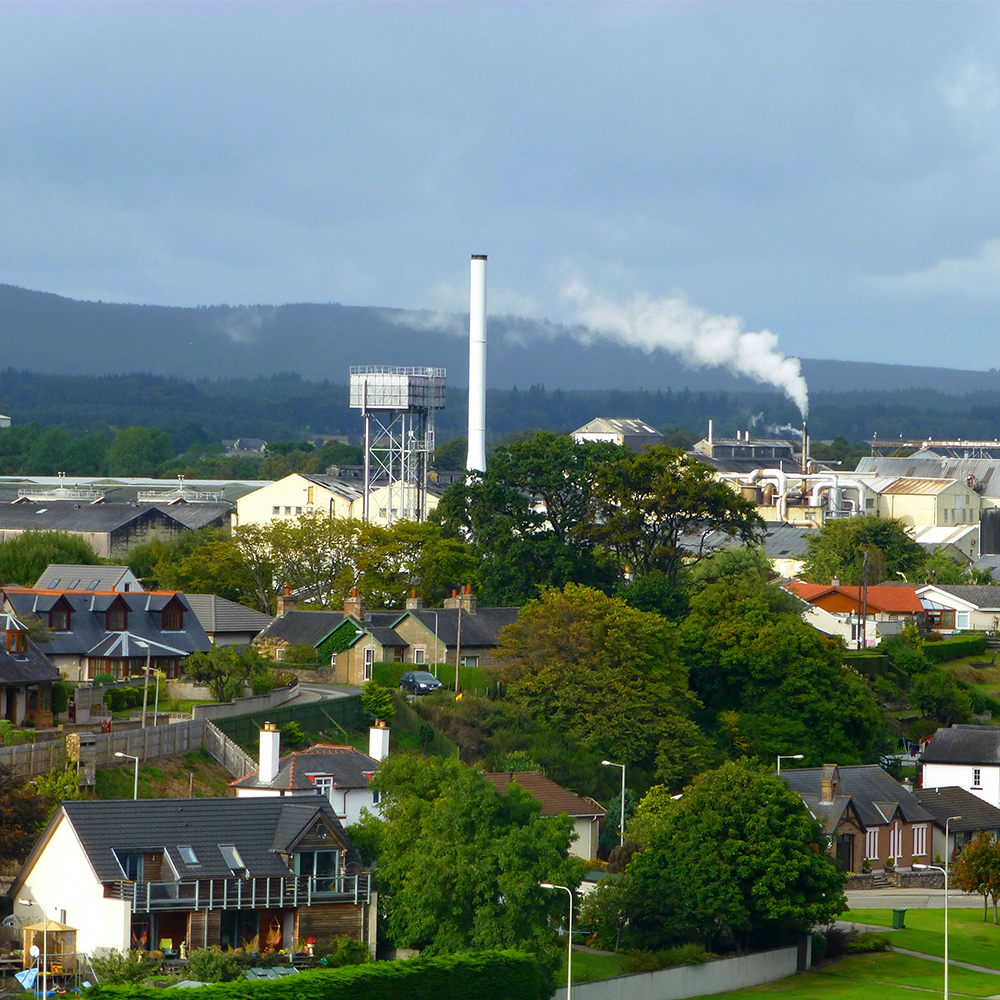
Invergordon Distillery
The grain distillery in the north
Invergordon started life in an unusual location for a grain distillery, yet thrives to this day, producing a whisky that ages extremely well
Most grain distilleries are not located in the Scottish Highlands. They are in the country’s Central Belt, for good reason. They are close to the blending and bottling plants; and grain has less distance to travel to them from the Borders, from East Anglia and further afield.
So why was a grain distillery opened on the Cromarty Firth, north of Inverness in 1961? Well, there is good arable land in the area, producing cereal crops. But, more importantly, for a location so far north, it had relatively good transport links, thanks to a deep-water port. The local landowner, William Gordon, had taken advantage of that in creating Invergordon as a manufacturing village, similar to the Cadbury family’s Bournville. Then, during the First World War, the Royal Navy took it over.
After the navy’s departure at the end of World War II, there was a need to return to manufacturing. And the government of the 1950s was keen to encourage development in the Highlands, offering incentives to entrepreneurs. The area was already associated with whisky – Invergordon lies between Dalmore and Glenmorangie – so, a grain distillery made sense.
Invergordon began producing in 1961, with a continuous distillation system (Coffey stills). Similar to the single malts of the Eastern Highlands, it has always had a medium-weight, rich and fruity character. This is partly thanks to a mash bill that includes wheat and maize; and to a relatively long fermentation time (70 hours) that brings out some tropical notes.
Like many grain distilleries, Invergordon did install a neutral grain spirit still to supply gin distillers; and, from the mid 1960s till 1977, also built a malt whisky distillery within the site, known as Ben Wyvis. (The old pot stills are now making Kilkerran whisky in Campbeltown.) However, since the 1970s, it has concentrated on its main purpose – grain whisky.
Invergordon’s spirit has been used in many a blend over the decades, as its parent company went through different hands (including, bizarrely, Hawker-Sidley, who built Hurricane fighters). Hands that make much more sense belong to its owner since 1993: White & Mackay Group. Invergordon is the basis of its eponymous blended Scotch, as well as other brands.
It also stands alone as a single-grain whisky if aged for a long time – the tropical fruit notes develop; oxidation reveals more complexity, with herbaceous notes coming in; and the sugars and vanillin integrate really well.